

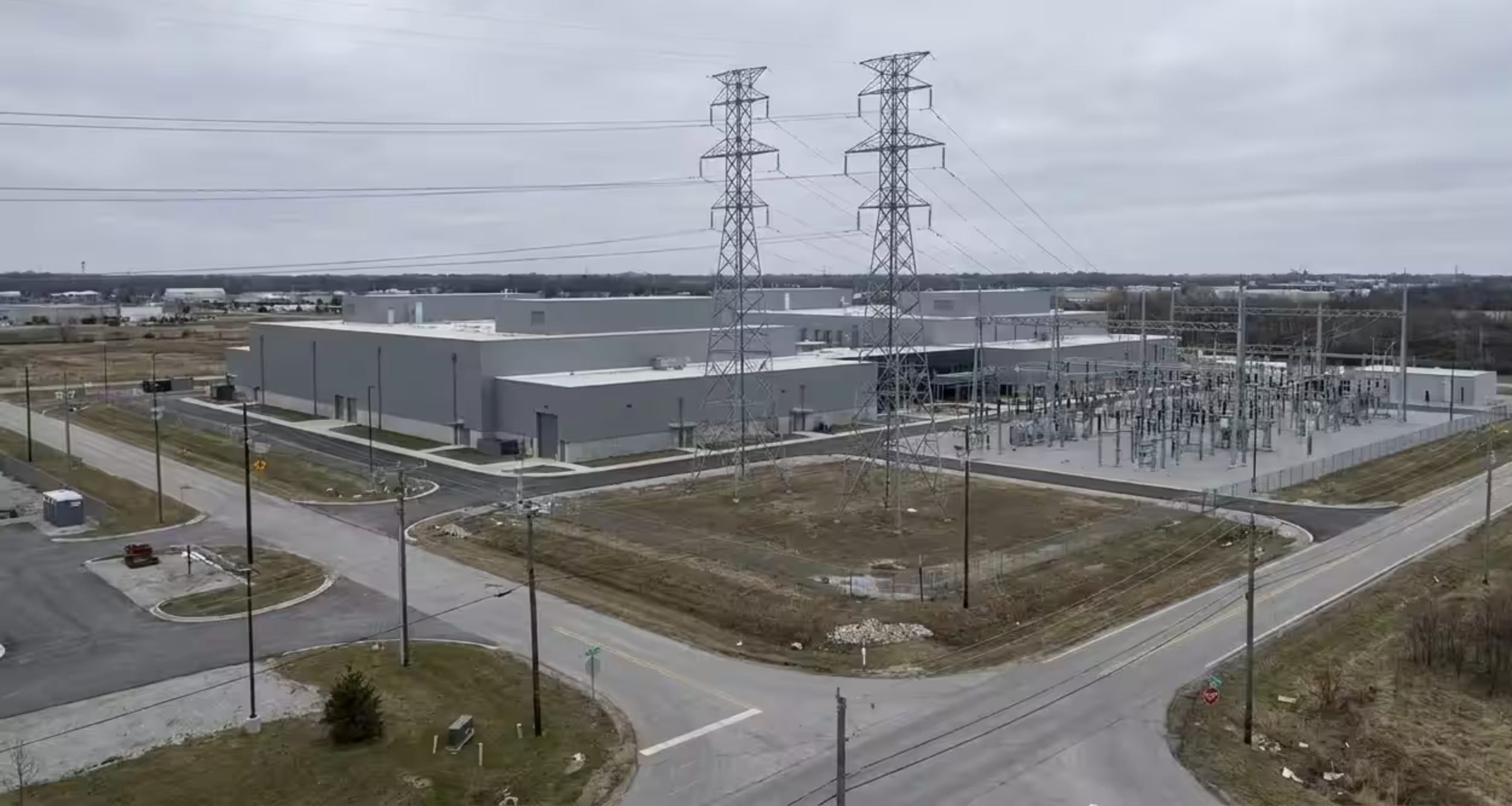
“You can’t fight it. You have to go with it.”
The President of the United States said that on July 23, at the headquarters of the Environmental Protection Agency. He was talking about data centers.
He would know that you can’t fight it. One year to the day earlier, he had signed the executive order.
The argument about the data center buildout runs the same way everywhere it happens:
“Nobody asked for this”, one side says. “We don’t need it”.
“You ask for it every time you unlock your phone”, the other side answers.
Both are wrong, and for the same reason: each assumes the demand in question is yours. Someone did ask for this. It was not for social media, and it was not for AI girlfriends.
AI and data centers are military technology.
That is not an inference. It is the stated position of the United States government, written down repeatedly, under two administrations, in documents anyone can read.
In March 2021 the National Security Commission on Artificial Intelligence — chartered by Congress, chaired by Eric Schmidt, formerly the chief executive of Google — delivered its final report. The Department of Defense and the intelligence agencies were to be ready to field artificial intelligence by 2025. The United States was to win the competition with China. The commission recommended pursuing autonomous weapons and argued against supporting an international ban on them. The people who wrote it were, to a considerable degree, the people who would build the systems it called for. Its governing metaphor was Sputnik, the Soviet satellite whose launch in 1957 taught Washington that a technology gap is an emergency in itself, irrespective of what the technology is for.
Congress’s own China commission went further. In its 2024 annual report the U.S.-China Economic and Security Review Commission made its first recommendation to Congress for the establishment and funding of a Manhattan Project-like program dedicated to acquiring an artificial general intelligence capability. It asked for broad multiyear contracting authority for the executive branch, funding directed at leading artificial intelligence, cloud, and data center companies, and the DX Rating — the Defense Department’s highest national-security priority designation. The one that lets a contract jump the queue ahead of every other order in a supplier’s book. The federal government is asking, in writing, to be allowed to treat this as a weapons program.
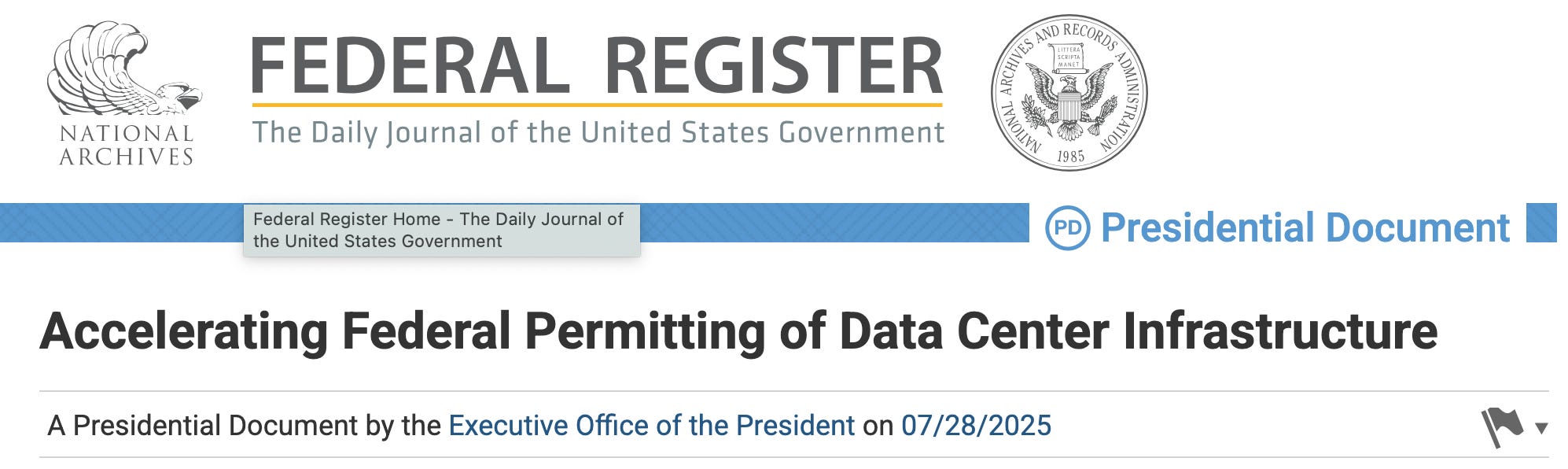
The policy followed, and it occurred under both parties. President Biden’s National Security Memorandum on artificial intelligence, issued in October 2024, was the first of its kind. It directed the Pentagon and the intelligence agencies to expand their use of these systems, and defined the AI supply chain to include not merely semiconductors and computing equipment but energy and power generation. Six days before leaving office Biden signed Executive Order 14141, opening federal land to frontier AI data centers, with clean-power obligations attached. The Trump administration left it standing for six months and then, on July 23, 2025, revoked it and replaced it with Executive Order 14318, Accelerating Federal Permitting of Data Center Infrastructure. It was the same prescription at greater scale, with the climate conditions stripped out. The order names the objects of the policy directly: AI data centers, and the infrastructure that powers them, including high-voltage transmission lines, substations and other equipment. It directs the use of federally owned land. It instructs the Environmental Protection Agency to identify Brownfield and Superfund sites as candidates for data center development, and it instructs the Secretary of Defense to identify suitable military installations. The Department of Energy named four federal sites the following day including the Oak Ridge Reservation — the lands of the federal nuclear complex, where the enrichment of uranium for Hiroshima occurred. The Energy Secretary, Chris Wright, announced the selections as a step toward what he called the next Manhattan Project.
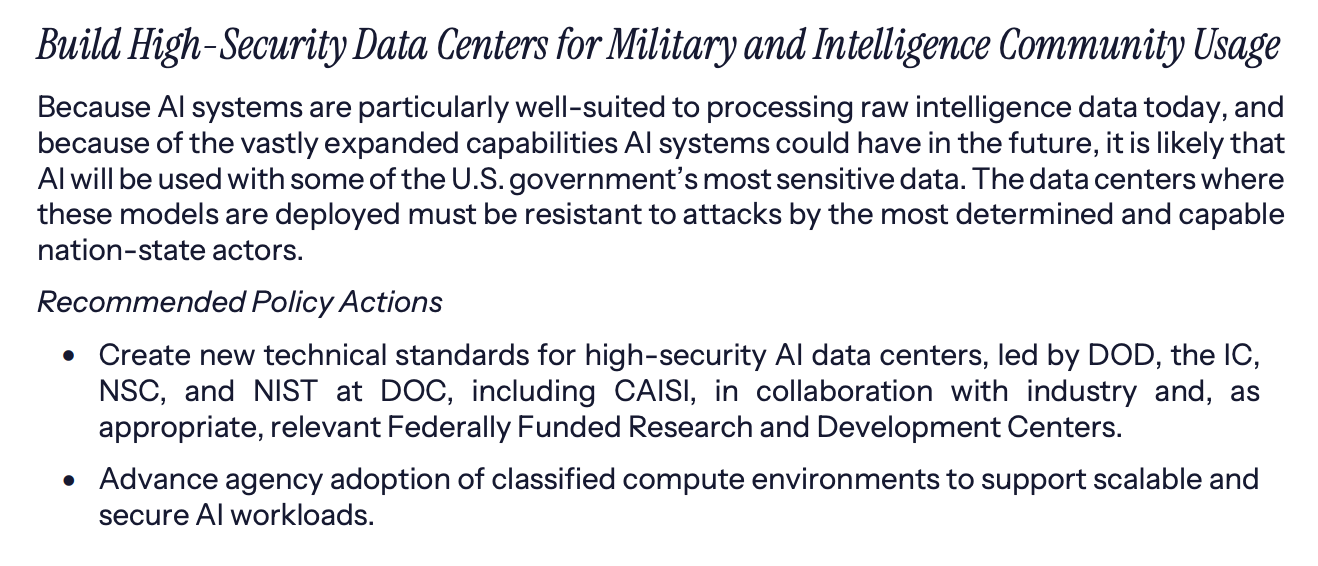
The administration’s AI Action Plan arrived the same day. Its title is Winning the Race. It opens on the proposition that whoever holds the largest AI ecosystem will set the global standards and collect the economic and military benefits, and that the United States must win this race the way it won the space race. It contains a section header that reads, in full: Build High-Security Data Centers for Military and Intelligence Community Usage.
Congress joined in December. The defense authorization signed that month prohibits the Department of Defense, and contractors performing its work, from using artificial intelligence from China, Russia, Iran, or North Korea. DeepSeek is named in the statute.
The industry, meanwhile, had named its three constraints without embarrassment: permitting, zoning, and power. The executive order addressed two of them. The third needed a different instrument.
A national defense material
The power constraint is severe. A transformer ordered for a new substation took roughly 140 weeks to arrive in 2023 and takes more than 160 now. That is over three years. As of early 2026 about 2,600 gigawatts were actively awaiting connection to the grid. That is double the entire active capacity of the current U.S. electrical grid. In Texas alone the grid operator is managing a 410-gigawatt large load queue in which data centers are 87 percent of the demand.
Underneath all of it sits an asymmetry that puts into perspective everything in this article. A data center is built in eighteen to twenty-four months. The transmission lines and substations that serve it take five to ten years.
In April of this year the President signed five determinations under Section 303 of the Defense Production Act of 1950 — the statute Congress wrote to mobilize American industry for the Korean War, which lets a president direct and subsidize private manufacturing in the name of national defense. The five covered grid infrastructure, coal, liquefied natural gas, petroleum, and large-scale energy. The grid determination finds that expanding the domestic capability to develop, manufacture, and deploy grid equipment and its supporting supply chains is necessary to avert a shortfall that would severely impair national defense capability.
The mechanism behind this strategy is procurement. The Defense Production Act waives the ordinary cost and competition rules for federal contracts so that the government can pay to build capacity — transformer factories under the grid determination, and fuel and generation under the other four: coal, liquefied natural gas, petroleum, large-scale energy. Grid equipment and the power to feed it are now national defense materials by presidential determination.
The same December statute rewrote the Pentagon’s high-performance computing roadmap to cover not only the department’s own machines but commercially procured cloud services, which is where the majority of the department’s computing actually lives. The Army is putting a commercially operated hyperscale data center inside Fort Bliss, expected to be online in 2027, with the operator free to sell surplus computing to its own customers and the Army taking a share of the compute as rent. The Air Force is opening unused land to data centers on five bases.
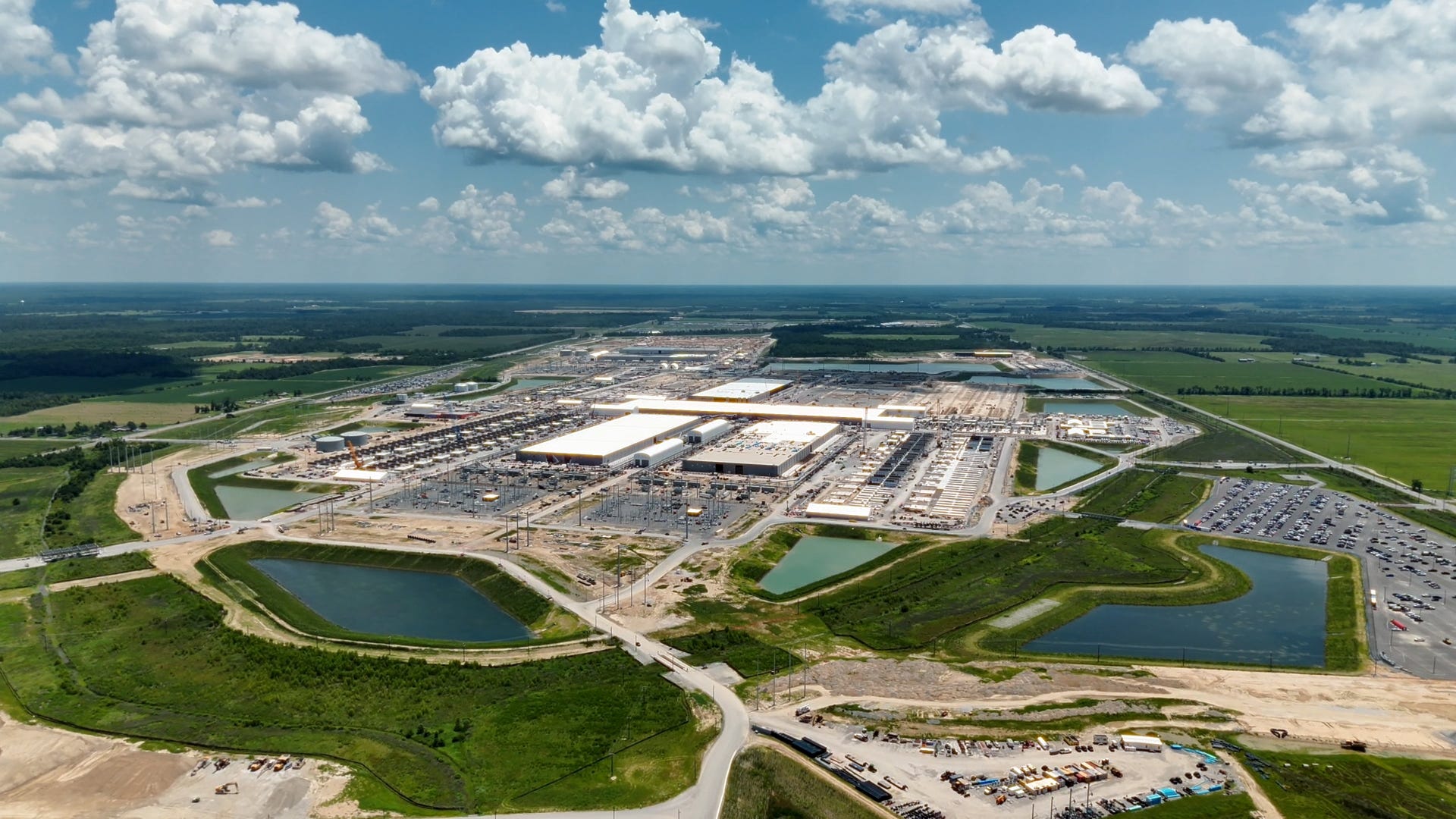
What this classification looks like on the ground is already visible in Richland Parish, Louisiana, where Meta is building its largest facility — four million square feet on 2,250 acres, thirty miles east of Monroe. To serve it, Entergy is putting nearly a hundred miles of new 500-kilovolt transmission line into the parish, eight new 230-kilovolt lines, and eight new substations. Then there is the power generation: ten gas plants totaling roughly 7.5 gigawatts — three approved last August, seven more proposed since and fast-tracked by the Louisiana Public Service Commission in April. That is more than six times the peak demand of New Orleans, in a parish with roughly 5% of its population –– 20,000 people. This is the power generation the executive order anticipated.
The 500-kilovolt power lines alone cost $1.2 billion, accelerated to come online by December. An Entergy executive, on camera, described it best: four months ago this was a dirt pile with some access roads.
But Meta’s accelerated schedule is an exception. The average timetable is two years for building a data center, and five to ten years for the electrical infrastructure needed to support it. The gap between those two tells us everything we need to know about what is to come. Shells of data centers sit finished without power, capacity contracted years ahead of the lines that will feed it, every year of it landing on a regulator, a county board, and the people along a proposed route. The new power-line fights are not a side note in the data center buildout, they are the main event, and it is just getting started.
Virginia’s utility regulator, approving the latest 500-kilovolt lines into Loudoun County — by some counts, the densest data-center concentration on earth — wrote that the infrastructure comes at a cost; fiscal, environmental, and societal, and allowed in a footnote that there may be a level of concentration that results in no reasonable transmission solution. That is a state utility regulator, in a final order, allowing that concentration may reach a point where no acceptable answer exists.
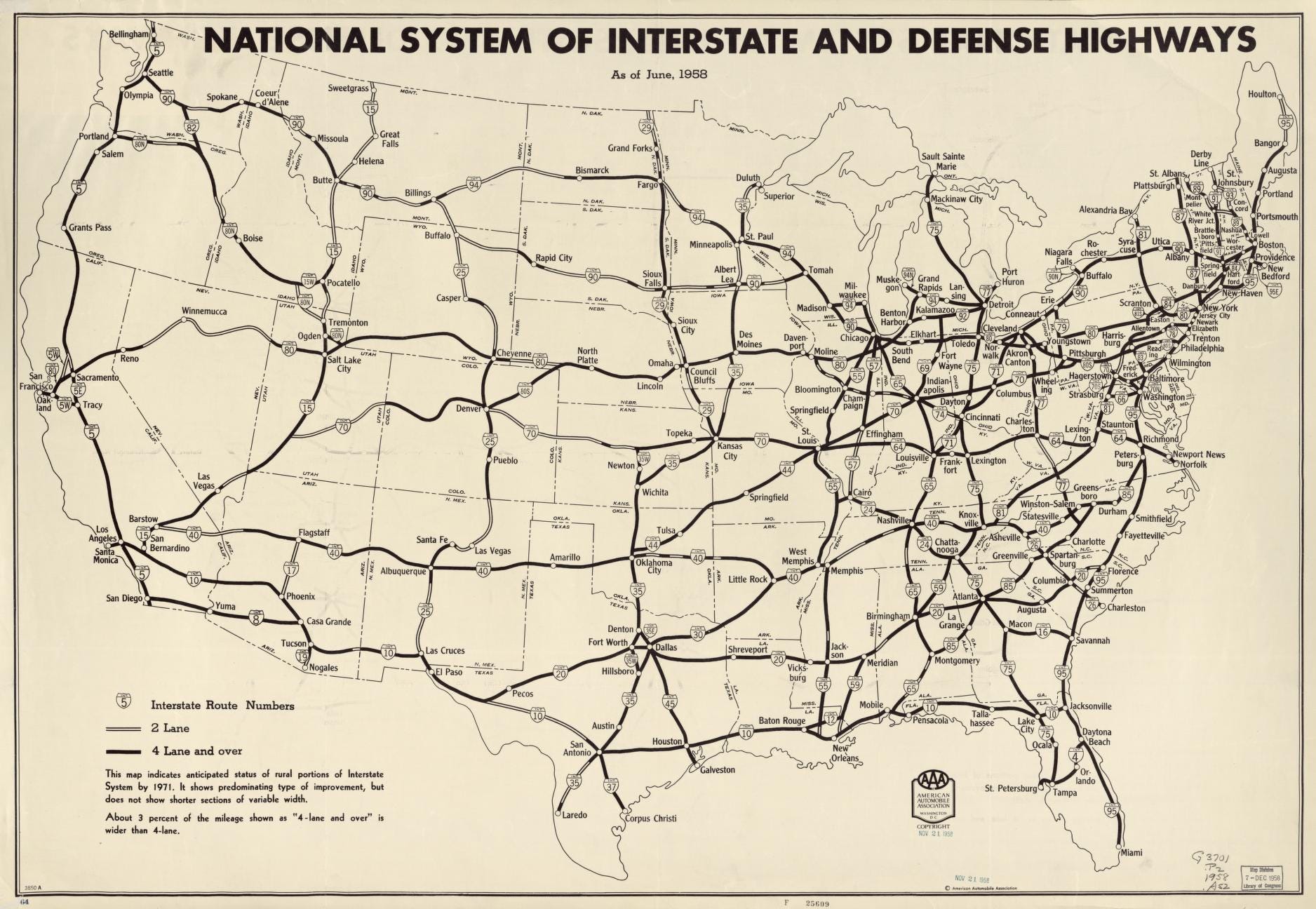
Generating capacity, transmission corridors, and the machines at the end of them have been gathered under the heading of national defense, but none of this is new. The interstate highway system was sold to the public on commerce and mobility, with civil defense evacuation and military convoy movement in the legislative record from the beginning. The 1956 statute that funded the system titled it the National System of Interstate and Defense Highways, which almost nobody who drives on it has ever noticed. The internet began as a Pentagon research network. GPS was a Defense Department satellite constellation for a decade before a civilian could buy a receiver. This is the ordinary way the country upgrades our infrastructure at continental scale: under a defense heading, with the civilian face assembled afterward.
“New Navy Device Learns By Doing”
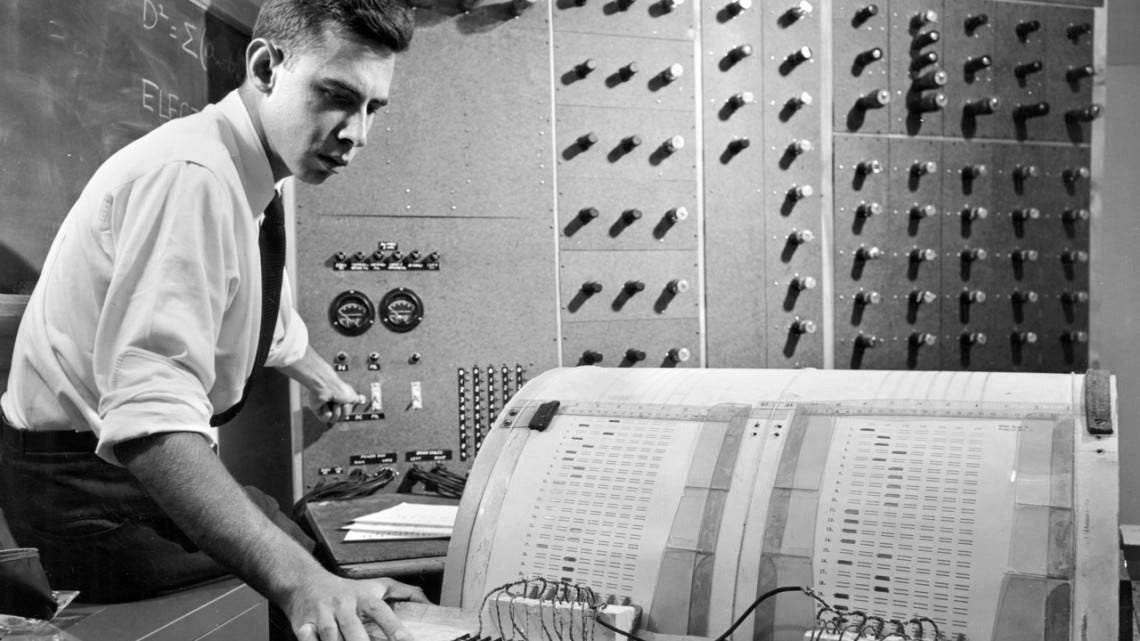
In January 1957 a research psychologist named Frank Rosenblatt, working at the Cornell Aeronautical Laboratory in Buffalo, filed a technical report proposing a machine that would learn to recognize patterns without being instructed how. The project was called PARA, for Perceiving and Recognizing Automaton. The money came from the Office of Naval Research and from the Rome Air Development Center, the Air Force laboratory in upstate New York. Over the following year Rosenblatt built a room-sized assembly of photocells, motor-driven potentiometers, and patch wiring that adjusted its own connection strengths as it was shown examples. He called it the perceptron.
In July 1958 it was the Office of Naval Research in Washington that announced it, demonstrating on an IBM 704 a machine that taught itself to tell cards marked on the left from cards marked on the right after fifty tries. The New York Times ran the story under the headline “New Navy Device Learns By Doing.” The Mark I Perceptron now sits in the Smithsonian, arriving there in 1967 as a transfer from the Office of Naval Research.

The Advanced Research Projects Agency, later DARPA, had been stood up within months of Sputnik as the Pentagon's answer to it. Four years after Rosenblatt's machine was announced, it created the Information Processing Techniques Office, and the field of artificial intelligence acquired a patron. A National Research Council study of the period puts the matter without qualification: from the 1960s through the 1990s, DARPA provided the bulk of the nation’s support for artificial intelligence research. The office’s founding director, J.C.R. Licklider, gave the reason in 1964: artificial intelligence was central to the agency’s mission because it was the key to advanced command-and-control systems.
That is what the money was allocated for. Not personal assistants, not chess, not even solving complex math problems. Command and control — the problem of an officer receiving more information than a staff can process and having to decide anyway.
MIT’s Project MAC was organized inside the broad command and control research program suggested by the Office of the Secretary of Defense; the Stanford Research Institute in Menlo Park was too. The major American centers of artificial intelligence research in that period were defense contractors. The early hardware was bootstrapped by the same money — the integrated circuit’s first customers were the Apollo guidance computer and the Minuteman missile, and Robert Noyce wrote in 1964 that military and space work would absorb more than ninety-five percent of that year’s output.
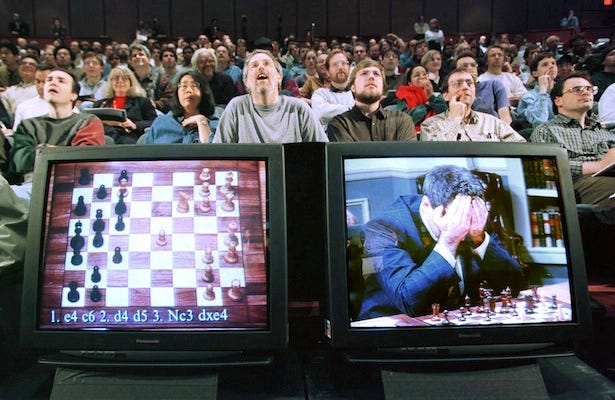
DARPA’s Strategic Computing program put roughly a billion dollars into artificial intelligence through the 1980s into the early 1990s, aimed at an autonomous land vehicle, a pilot’s associate, and battle management. In 1991 a DARPA-funded planning system called DART scheduled the logistics of the Gulf War deployment, and the agency later said that single application had repaid its entire thirty-year investment in the field. The only thing the public ever saw was a chess match: IBM’s Deep Blue beating the world champion, Garry Kasparov, in 1997.
In May 2003 DARPA launched the Personalized Assistant that Learns program, a five-year program funded at up to two hundred million dollars by some accounts, drawing more than three hundred researchers from some two dozen institutions. SRI International was the lead integrator, and its component carried the name CALO — Cognitive Assistant that Learns and Organizes. The acronym was fitted to a Latin word the researchers chose first: calonis. A soldier’s servant. The program was to make military decision-making more efficient at multiple levels of command, to reduce the need for large command staffs, and to enable smaller, more mobile, and less vulnerable command centers. Elements of that system went into the Army’s Command Post of the Future. Forty years after Licklider said the money was for command and control, the money was still for command and control.
In December 2007 three men spun a company out of SRI to commercialize the natural-language piece. Apple bought it in April 2010 for a reported two hundred million dollars, and in October 2011 the soldier’s servant shipped inside the iPhone 4S under the name Siri.
Until CALO, the artificial intelligence DARPA built was symbolic, meaning systems navigate complex, pre-defined chains of logic to emulate reasoning by following explicit rules. This avenue eventually hit a dead end due to the common sense knowledge problem: it is simply impossible to write a rule for every single real-world scenario. That program largely died. What replaced it was a statistical approach. Rules were replaced by probabilities computed from massive datasets. The agency calls this the second wave of AI, and it paid for that one too.
DARPA’s Grand Challenge, announced in 2003 and run in 2004, put a hundred and forty-two miles of Mojave desert in front of driverless vehicles with a million dollars for any car that completed the journey. None of them did. The furthest went seven miles. The next year five cars finished. The winner was a Volkswagen from Stanford nicknamed “Stanley” that had found a novel approach; rather than calculating obstacles and routing around them, it started calculating the odds that a patch of ground would hold a car. The Urban Challenge moved the cars from the desert to a mock urban environment in 2007, complete with traffic. EARS did the same for speech from 2002 to 2004, and GALE for translation from 2005 to 2011. There were no rules of grammar, just the probability that this word answers to that one, computed across enormous bodies of data.
In 2010 DARPA started a program called Deep Learning, to build machines that could take in a large unlabeled dataset and find the patterns in it without being told what to look for. The principal investigators worked at Stanford, NYU, Montréal, and Penn, and the agency’s own account of the program notes that many of them are now recognized as leaders in the field. The 2012 breakthrough that jump-started the field commercially ran on consumer graphics processors built for video games. In March 2013 the agency funded probabilistic programming — PPAML to put statistical modeling in the hands of people who were not statisticians. The architecture underneath every current large language model came out of a Google research paper in 2017 motivated by machine translation.
Sixty years had passed since the Perceptron, and the money had never stopped. Then the funding itself went hyperscale.
All lawful purposes
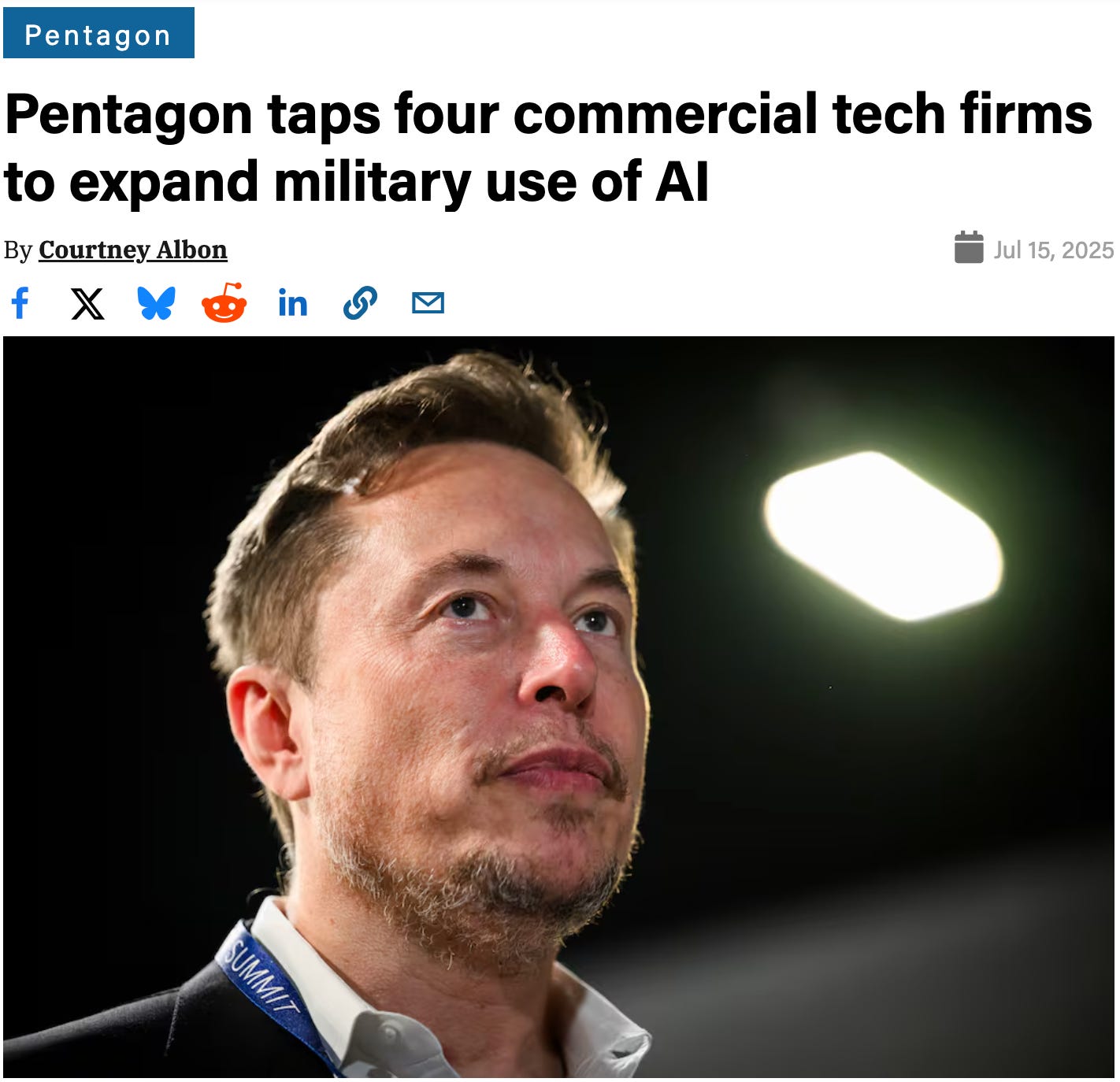
In July 2025 the Defense Department awarded contracts worth up to two hundred million dollars each to Anthropic, Google, OpenAI, and xAI. Anthropic’s system, called Claude, was by the company’s account the most widely deployed frontier model in the department — frontier being the industry’s word for the largest and most capable general-purpose systems — and, by press accounts, the only one available on the department’s classified networks, used for intelligence analysis, modeling and simulation, operational planning, and cyber operations. Reporting indicates it was used in the January 2026 operation that captured the Venezuelan president, Nicolás Maduro.
During contract negotiations the Pentagon asked the AI companies to permit use of their models for all lawful purposes. Anthropic was willing to adapt its usage policy and unwilling to permit two things: mass domestic surveillance, and fully autonomous weapons — machines that select and engage targets with no person in the loop. Its chief executive, Dario Amodei, wrote that autonomous weapons may prove critical to national defense but that today’s systems are not reliable enough to power them, and that mass domestic surveillance of Americans violates fundamental rights. The Under Secretary of Defense for Research and Engineering, Emil Michael, who had led the negotiations, later said the dispute followed an argument over how artificial intelligence would be used in Golden Dome, the continental missile-defense system Trump ordered built in his first week back in office, and that he had come to regard the company’s restrictions as an irrational obstacle.
On February 27, 2026, the President directed federal agencies to immediately cease all use of Anthropic’s technology. The Secretary of Defense, Pete Hegseth, directed his department to designate the company a supply-chain risk to national security — an instrument built to keep foreign adversaries out of American defense systems, reserved until then for firms like Huawei and ZTE, and never before applied to an American company. No contractor, supplier, or partner doing business with the United States military, he announced, could conduct any commercial activity with Anthropic. Across the government, agencies struck the company from purchasing schedules and inventories and stopped using the product. The Pentagon, over the same period, agreed to classified use of models from seven other firms.
A federal judge blocked it all in March — the designation and the cease-use order both — calling the government’s measures Orwellian, and an effort to cripple the company. Access was restored. The government is appealing, and at a hearing in late July the judge observed that the record had gotten worse for the government. The case is unresolved as I write this.
The administration was not finished. In June, days after Anthropic released its newest models, the Commerce Department invoked export controls to bar foreign nationals from using them, citing a possible jailbreak of the models’ safeguards — an order so broad the company said it had no choice but to shut the models off for everyone, worldwide. Three weeks later the order was lifted, after the company and the administration worked out guardrails: the flagship model, Fable, came back for the public, but the most powerful one, Mythos, came back only for organizations the federal government approves. The same month, the President signed an executive order creating a framework for the government to vet the most advanced models for national-security risk before the public ever sees them, and OpenAI held back its own new model at the administration’s request.
Now follow the whole sequence. A private firm proposed two limits on military use — surveillance of Americans, and machines that kill without a person deciding — and the government answered by designating it a threat to national security and instructing its partners to stop doing business with it. Then the government imposed guardrails of its own, deciding who may use the company’s most capable model, claiming the right to review what it builds before release. These disputes are never over whether the technology will be governed, but always over who makes the final call. At least Anthropic got a seat at the table.
You can’t fight it
Anthropic could absorb its fight. It has lawyers and a balance sheet. The people who live next to the data centers, substations, and transmission lines have yard signs and petitions. In Maryland, where a sixty-seven-mile line is proposed through three counties to carry data-center load, the farmers call it an extension cord for data centers, the signs along the highway read No eminent domain for corporate gain, and the utility has sued landowners who refused its survey crews access. (What is almost never in these fights is the health question, and inside it two words: magnetic field. That is a separate article.)
Which brings us back to the Environmental Protection Agency. What the President was unveiling on July 23 was the Ratepayer Protection Pledge — a voluntary commitment by tech companies, utilities, and now twenty-three Republican governors that data centers will pay their own way on the grid. Whether they do is a question for the utility commissions, and it will take years to answer. The pledge is the only part of this that is voluntary. He told the room the communities would get rich, that the protection was automatic, that if they didn’t take the money somebody else would. The pledge exists because the fights are working. In the first four months of this year communities blocked more than seventy-five data center projects worth some hundred and thirty billion dollars, and seven in ten Americans say they do not want one near their home. You do not stand at a podium telling people they can’t fight something unless they are fighting it.
The interstates ran the same arc. Robert Moses, who put more miles of highway through more neighborhoods than any builder in American history, worked on the principle the President announced at the EPA — inevitability, stated as fact until it became one. He lost, eventually, in lower Manhattan, where the expressway that would have destroyed parts of SoHo and Little Italy was never built. He lost again in Portland, which had hired him in 1943 to draw its freeway plan. The plan the city eventually fought grew out of it. The Mt. Hood Freeway died in 1974, after the state had begun buying the right-of-way. The federal money went to light rail instead. Three off-ramps still hang unfinished over the east side of the city, stubs of another road from the same plan. The victories were real, but they were local, and they came long after the system had largely been completed — with Defense still in its statutory name.
This new system is only at its beginning. Golden Dome — the missile shield that put the Pentagon and Anthropic at odds — is priced by the President at a hundred and seventy-five billion dollars over three years. The Congressional Budget Office estimated $1.2 trillion, pricing out the system of thousands of space-based interceptors over twenty years. It began as the Iron Dome for America, and was renamed to distinguish it from the Israeli system it dwarfs. It is to run on artificial intelligence. Its boosters have compared the program to Apollo and the Manhattan Project. Whatever the data centers are for today, that is what they are for next.
What is being built may deliver more than its critics expect. I am optimistic — I use these systems every day, and they allow me to do work that would once have required an entire team of software engineers, and a cohort of PhD research assistants. But these models are statistical systems and they have no account of their own answer. They can tell you what they predict to be right, not the reason, and they cannot tell you when they’re wrong. DARPA started funding what comes next nearly a decade ago — a third wave, machines that can explain their own reasoning. Whatever these models turn out to be worth, they are likely going to require even more computational power. When the President told the room “You can’t fight it”, he wasn’t making a prediction. He was describing orders that he had signed.
Somebody asked for it. Nobody asked us. Nobody ever does.
For the early history of machine intelligence, the National Research Council’s Funding a Revolution is the authoritative account of the reasearch that DARPA funded, and DARPA’s own program pages are more candid than anything written about them. The President’s July 23 remarks at the Environmental Protection Agency were reported by the Associated Press and are on video below.
Technology Is a Double-Edged Sword is an occasional series, interspersed between the research and investigative pieces. The first installment covered the clock.
Citations
Opening
“You can’t fight it” — July 23, 2026, EPA headquarters
https://www.oann.com/newsroom/23-governors-sign-trump-led-cost-pledge-to-power-ai-data-centers/
https://www.timesfreepress.com/news/2026/jul/23/tva-signs-trumps-ratepayer-protection-pledge-for/
https://apnews.com/article/trump-ai-data-centers-pledge-490ea7e4c7227d5e550b00a0056c33c9
EO 14318 signed one year earlier, July 23, 2025
https://www.federalregister.gov/documents/2025/07/28/2025-14212/accelerating-federal-permitting-of-data-center-infrastructure
The documents
NSCAI final report, March 2021
https://reports.nscai.gov/final-report
https://irp.fas.org/offdocs/ai-commission.pdf
USCC 2024 annual report — Manhattan Project recommendation, DX Rating
https://www.uscc.gov/sites/default/files/2024-11/2024_Annual_Report_to_Congress.pdf
Biden National Security Memorandum on AI, October 2024
https://www.govinfo.gov/content/pkg/DCPD-202400945/pdf/DCPD-202400945.pdf
https://www.csis.org/analysis/biden-administrations-national-security-memorandum-ai-explained
EO 14141 — federal land opened to AI data centers, clean-power obligations
https://www.presidency.ucsb.edu/documents/executive-order-14141-advancing-united-states-leadership-artificial-intelligence
https://www.govinfo.gov/app/details/DCPD-202500057
EO 14318 — revocation of 14141; transmission lines, substations, federal land, Brownfield/Superfund, military installations
https://www.federalregister.gov/documents/2025/07/28/2025-14212/accelerating-federal-permitting-of-data-center-infrastructure
https://www.whitehouse.gov/presidential-actions/2025/07/accelerating-federal-permitting-of-data-center-infrastructure/ https://www.workforcebulletin.com/from-data-centers-to-ideology-decoding-the-latest-ai-executive-orders
DOE names four federal sites; Wright’s “next Manhattan Project”
https://www.energy.gov/articles/doe-announces-site-selection-ai-data-center-and-energy-infrastructure-development-federal
https://www.eenews.net/articles/doe-picks-4-sites-to-build-data-centers-on-federal-land/
Oak Ridge enriched the uranium for Hiroshima
https://www.nps.gov/mapr/learn/uranium.htm
AI Action Plan, Winning the Race
https://www.whitehouse.gov/wp-content/uploads/2025/07/Americas-AI-Action-Plan.pdf
FY2026 NDAA — foreign AI prohibition, DeepSeek named (§1532)
https://www.congress.gov/crs-product/IF13197
https://ofac.treasury.gov/system/files/2025-12/NDAA_FY2026.pdf
https://www.akingump.com/en/insights/alerts/congress-moves-forward-with-ai-measures-in-key-defense-legislation
A national defense material
Transformer lead times
https://www.manufacturingmag.com/article/wood-mackenzie-reshoring-bottleneck-electricity
Interconnection queue, ~2,600 GW
https://emp.lbl.gov/news/backlog-power-plants-seeking-transmission-grid-connection-eased-somewhat-2025-amidst
ERCOT large-load queue, 410 GW / 87 percent
https://www.ercot.com/files/docs/2026/04/01/ERCOT_LargeLoad_Update_April2026_B-C_-Hearing.pdf
Build timelines — data center vs. transmission
https://www.camus.energy/blog/why-does-it-take-so-long-to-connect-a-data-center-to-the-grid
https://broadstaffglobal.com/data-center-construction-timeline
Five DPA §303 determinations, April 2026
https://www.federalregister.gov/documents/2026/04/23/2026-07900/notice-pursuant-to-the-defense-production-act-of-1950
https://www.novoco.com/notes-from-novogradac/the-five-defense-production-act-presidential-determinations-signal-another-broad-push-away-from-traditional-renewables-but-support-for-grid-infrastructure-could-be-a-boon-though-implementation-remains-uncertain
NDAA §1531 — computing roadmap, installation assessments
https://www.akingump.com/en/insights/alerts/congress-moves-forward-with-ai-measures-in-key-defense-legislation
https://ofac.treasury.gov/system/files/2025-12/NDAA_FY2026.pdf
Fort Bliss hyperscale data center
https://www.army.mil/article/291360/army_reaches_conditional_agreement_with_private_industry_for_hyperscaled_data_centers
Air Force opening land on five bases
https://federalnewsnetwork.com/federal-newscast/2025/10/air-force-opening-up-unused-land-on-five-military-bases-for-private-ai-centers/
Richland Parish — transmission, substations, project scale
https://www.entergy.com/news/entergy-louisiana-power-meta-s-data-center-in-richland-parish
https://www.datacenterdynamics.com/en/news/entergy-breaks-ground-on-two-natural-gas-plants-for-metas-2gw-data-center-in-richland-parish-louisiana/
https://www.industrialinfo.com/iirenergy/industry-news/article/louisiana-greenlights-massive-power-projects-for-meta-data-center--345274
https://www.enr.com/articles/62766-27b-meta-data-center-pushes-louisiana-toward-massive-power-expansion
Ten gas plants, ~7.5 GW; three approved over community pushback; seven fast-tracked; six times New Orleans peak demand
https://www.ucs.org/about/news/louisiana-regulators-fast-track-7-gas-plant-proposal-meta-data-center
https://www.knoe.com/2026/04/15/entergy-asks-public-service-commission-approve-new-energy-investments-power-richland-parish-meta-center/
https://www.kalb.com/2026/04/15/entergy-seeks-fast-tracked-approval-seven-new-power-plants-meta-data-center/
“A dirt pile with some access roads”; TV crew refused access
https://www.fox8live.com/2026/05/12/metas-27-billion-ai-data-center-is-transforming-rural-louisiana/
Virginia SCC final order, Case No. PUR-2025-00056
https://cdn-dominionenergy-prd-001.azureedge.net/-/media/content/about/power-line-projects/nova/pdfs/20260409-pur202500056.pdf
1956 highway act — National System of Interstate and Defense Highways; civil defense in the record
https://www.fhwa.dot.gov/programadmin/interstate.cfm
https://www.govinfo.gov/features/federal-highway-act-1956
“New Navy Device Learns By Doing”
Rosenblatt, Project PARA, ONR contract
https://kube-dojo.github.io/ai-history/ch-14-the-perceptron/
July 1958 ONR demonstration, IBM 704, fifty trials
https://news.cornell.edu/stories/2019/09/professors-perceptron-paved-way-ai-60-years-too-soon
NYT, “New Navy Device Learns By Doing,” July 8, 1958
https://www.nytimes.com/1958/07/08/archives/new-navy-device-learns-by-doing-psychologist-shows-embryo-of.html
https://arxiv.org/pdf/2002.04806
Mark I Perceptron at the Smithsonian
https://americanhistory.si.edu/collections/object/nmah_334414
DARPA as the field’s patron; Licklider on command and control; Project MAC —
https://nap.nationalacademies.org/catalog/6323/funding-a-revolution-government-support-for-computing-research
https://www.nationalacademies.org/read/6323
Integrated circuits — Apollo and Minuteman; Noyce’s 95 percent
https://spectrum.ieee.org/how-much-did-early-transistors-cost
Strategic Computing Initiative, ~$1B, 1983–1993
https://mitpress.mit.edu/9780262529266/strategic-computing/
https://warontherocks.com/cautionary-tale-on-ambitious-feats-of-ai-the-strategic-computing-program/
DART and the thirty-year payback claim — Russell & Norvig, Artificial Intelligence: A Modern Approach
CALO / PAL
http://adam.cheyer.com/pal.pdf
https://en.wikipedia.org/wiki/CALO
Siri spinout, Apple acquisition, iPhone 4S
https://www.alphr.com/features/373546/10-brilliant-darpa-inventions/
2017 transformer architecture paper
https://arxiv.org/abs/1706.03762
Symbolic to statistical — DARPA’s own framing of its “second wave”
https://www.darpa.mil/research/programs/ai-next-campaign
John Launchbury, A DARPA Perspective on Artificial Intelligence, DARPA, 2017 — https://www.darpa.mil/about/innovation-timeline/ai-next
Grand Challenge 2004 and 2005 — 142 miles, no finishers, seven miles, Stanley
https://www.darpa.mil/about/innovation-timeline/grand-challenge
Urban Challenge, 2007
https://www.darpa.mil/about/innovation-timeline/darpa-urban-challenge
EARS — Effective Affordable Reusable Speech-to-Text, 2002–2004
https://www.danielpovey.com/files/ieee_trans_ears_2006.pdf
https://tsapps.nist.gov/publication/get_pdf.cfm?pub_id=932302
GALE — Global Autonomous Language Exploitation, 2005–2011
https://www.federalgrants.com/Global-Autonomous-Language-Exploitation-GALE-1282.html
http://www.speech.sri.com/projects/GALE/
http://link.springer.com/content/pdf/10.1007/978-1-4419-7713-7.pdf
BOLT — Broad Operational Language Translation, launched October 2011
https://www.darpa.mil/research/programs/broad-operational-language-translation
Deep Learning program, 2010 — unlabeled data, PIs at Stanford, NYU, Montréal, Penn
https://www.darpa.mil/news/features/deep-learning
https://www.darpa.mil/sites/default/files/DEEPLEARNING_Layout_Final.pdf
PPAML — Probabilistic Programming for Advancing Machine Learning, March 2013, 46 months
https://www.darpa.mil/research/programs/probabilistic-programming-for-advancing-machine-learning
All lawful purposes
Claude most deployed; only frontier model on classified networks; use cases; Maduro operation
https://www.americanprogress.org/article/the-department-of-defenses-conflict-with-anthropic-and-deal-with-openai-are-a-call-for-congress-to-act/
https://www.theguardian.com/technology/2026/feb/14/us-military-anthropic-ai-model-claude-venezuela-raid
“All lawful purposes”; the two refusals; Amodei’s statements
https://www.everycrsreport.com/reports/IN12669.html
Emil Michael, Golden Dome dispute, “irrational obstacle”
https://apnews.com/article/ai-anthropic-pentagon-golden-dome-autonomous-weapons-6f3c45ff46172c1bf8658dea0098f3fe
February 27 cease-use; Hegseth supply-chain designation; contractor bar; Huawei/ZTE precedent; seven other firms
https://www.congress.gov/crs-product/IF13217
https://www.everycrsreport.com/reports/IF13217.html
https://blog.volkovlaw.com/2026/06/when-the-government-pulls-the-plug-anthropic-export-controls-and-the-future-of-ai-governance/
https://www.americanprogress.org/article/the-department-of-defenses-conflict-with-anthropic-and-deal-with-openai-are-a-call-for-congress-to-act/
OpenAI’s classified-networks contract, hours later
https://openai.com/index/our-agreement-with-the-department-of-war/
March injunction — “Orwellian,” “cripple,” access restored
https://www.courtlistener.com/docket/72379655/anthropic-pbc-v-us-department-of-war/
https://www.techradar.com/pro/orwellian-notion-federal-workers-can-access-claude-ai-after-judge-ditches-trumps-anthropic-ban
https://www.cbsnews.com/news/anthropic-trump-administration-lifted-claude-restrictions/
Late-July hearing, “the record has gotten worse”
https://fedscoop.com/anthropic-federal-government-federal-court/
June export controls; global shutoff; guardrails; Fable public, Mythos gated; pre-release vetting EO; OpenAI holds back its model
https://blog.volkovlaw.com/2026/06/when-the-government-pulls-the-plug-anthropic-export-controls-and-the-future-of-ai-governance/
https://www.usnews.com/news/business/articles/2026-07-01/trump-administration-lifts-restrictions-on-anthropics-claude-models-after-cybersecurity-alarm
https://www.washingtontimes.com/news/2026/jul/1/trump-administration-lifting-restrictions-anthropics-claude-models/
You can’t fight it
Maryland Piedmont line — sixty-seven miles, “extension cord,” survey lawsuits
https://www.nbcnews.com/news/us-news/maryland-farmers-data-centers-extension-cord-power-lines-rcna233324
Magnetic fields absent from the fights

Ratepayer Protection Pledge — voluntary, tech companies, utilities, twenty-three Republican governors
https://www.oann.com/newsroom/23-governors-sign-trump-led-cost-pledge-to-power-ai-data-centers/
https://www.timesfreepress.com/news/2026/jul/23/tva-signs-trumps-ratepayer-protection-pledge-for/
https://thehill.com/policy/energy-environment/5986955-trump-data-centers-power-bills/
https://www.wspa.com/news/national/trump-republican-governors-sign-ai-data-center-pledge-aimed-at-limiting-utility-rate-increases/
https://www.theblaze.com/news/you-cant-fight-it-trump-defends-data-centers-signs-up-23-governors-to-shield-americans-from-price-hikes
Seventy-five projects blocked, ~$130B, first four months of 2026; seven in ten opposed
https://www.tomshardware.com/tech-industry/artificial-intelligence/more-than-75-data-center-build-outs-worth-usd130-billion-have-been-successfully-blocked-in-the-first-four-months-of-2026-bipartisan-opposition-mounts-nationwide-over-fears-of-soaring-power-and-water-costs
Moses’s record; LOMEX never built — Robert Caro, The Power Broker
Portland hires Moses in 1943; Mt. Hood Freeway killed in 1974; money to light rail; unfinished off-ramps
https://www.wweek.com/portland/article-23466-feb-4-1974-portland-kills-the-mount-hood-freeway.html
https://www.oregonencyclopedia.org/articles/mt__hood_freeway/
https://www.wweek.com/news/dr-know/2025/05/05/why-are-three-unfinished-freeway-off-ramps-dangling-over-the-void/
Golden Dome — Trump’s $175B, CBO’s estimate, Apollo/Manhattan comparison
https://www.atlanticcouncil.org/dispatches/golden-dome-needs-a-price-tag-and-a-clear-objective-to-succeed/
https://www.sec.gov/Archives/edgar/data/2102041/000121390026068925/ea0294863-425_inflection6.htm
David Gunning et al., "DARPA's explainable AI (XAI) program: A retrospective," Applied AI Letters, 2021